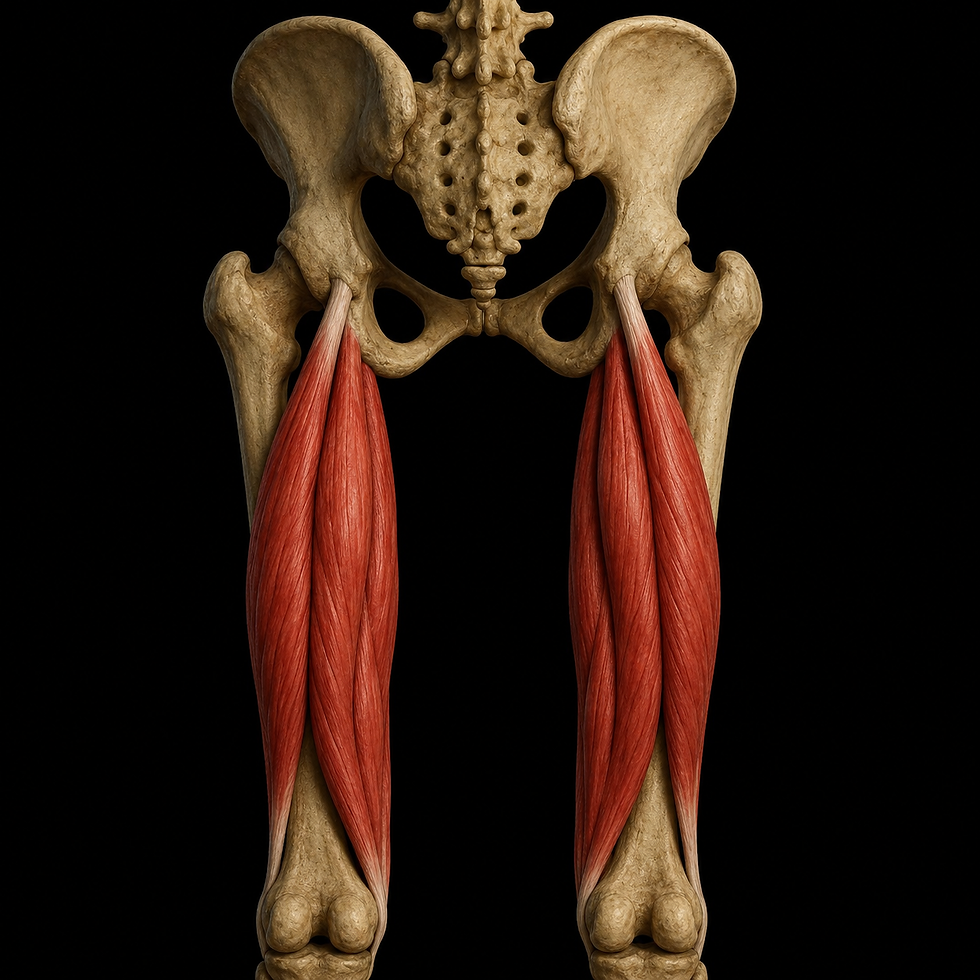
Teres Major

The teres major is a thick, rounded muscle located on the inferior portion of the posterior surface of the scapula. It is not considered part of the rotator cuff, but it works closely with the latissimus dorsi and, to some extent, the subscapularis in movement and stabilization of the upper extremity.

Origin and insertion
Origin
The teres major originates from the inferior third of the lateral (axillary) border of the scapula, also referred to as the margo lateralis scapulae. The attachment is located on the posterior aspect of the scapula, close to the inferior angle.
• The origin begins just superior to the attachment of the latissimus dorsi.
• It lies directly inferior to the teres minor.
• The muscle attaches directly to the bony margin of the scapula.
• The muscle fibers run in a superolateral direction, meaning upward and slightly laterally.
Insertion
The teres major inserts on the crista tuberculi minoris humeri, also known as the medial lip of the intertubercular sulcus of the humerus.
• This is the same general insertion area as the latissimus dorsi.
• The teres major lies slightly more medial and superficial at the insertion.
• This attachment allows the muscle to pull the humerus posteriorly and medially.
• The insertion contributes to medial rotation of the humerus.
In short:
• Origin: inferior part of the lateral border of the scapula.
• Insertion: crest of the lesser tubercle of the humerus.
Innervation
The teres major is innervated by the inferior subscapular nerve.
• Nerve: inferior subscapular nerve.
• Root values: C5–C7, most commonly C6.
• Origin: posterior cord of the brachial plexus.
• This nerve should not be confused with the thoracodorsal nerve, which innervates the latissimus dorsi.
Clinically, injury to the inferior subscapular nerve, for example following axillary surgery, may lead to weakness in medial rotation and extension of the arm.
Blood supply
The blood supply of the teres major is derived from multiple sources.
• Circumflex scapular artery.
• Thoracodorsal artery.
• Small branches from the subscapular artery may also contribute.
These vessels form an anastomotic network around the scapula, ensuring adequate perfusion during shoulder movement.
Position and relations
General position
The teres major is positioned inferiorly in the posterior shoulder region, extending from the scapula to the anterior aspect of the humerus.
• Inferior to the teres minor.
• Superior and lateral to the latissimus dorsi, with partial convergence before insertion.
• Posterior to the long head of the triceps brachii.
Anatomical spaces
The teres major forms important boundaries of anatomical spaces in the shoulder region.
Triangular space
• Superior border: teres minor.
• Inferior border: teres major.
• Medial border: long head of the triceps brachii.
• Contents: circumflex scapular artery.
Quadrangular space
• Superior border: teres minor.
• Inferior border: teres major.
• Medial border: long head of the triceps brachii.
• Lateral border: humerus.
• Contents: axillary nerve and posterior circumflex humeral artery.
These spaces are clinically relevant, as compression or injury to their contents can affect shoulder and upper arm function.
Function
Although the teres major is not part of the rotator cuff, it plays a significant role in controlled shoulder movement and force production.
Primary functions
• Medial rotation of the humerus.
• Adduction of the arm toward the body.
• Extension of the arm from a flexed position.
Secondary roles
• Stabilization of the humeral head during heavy lifting and pulling movements.
• Synergistic action with the latissimus dorsi and pectoralis major during functional movement patterns.
• Important contributor during activities such as climbing, rowing, swimming, and powerful pulling tasks.
Examples from daily life
The teres major is activated during a wide range of functional movements, including:
• Pulling a heavy door toward the body
• Pulling oneself up on a rope or ladder
• Lowering the arm in a controlled manner from an overhead position to the side of the body
The muscle works especially eccentrically during the final phase of these movements, requiring a high degree of neuromuscular control.
Injury patterns and clinical relevance
The teres major is a strong and robust muscle, and isolated injuries are relatively uncommon. However, due to its involvement in multiple movement chains, it may be affected by overuse, faulty loading patterns, or indirectly through shoulder pathology.
Common clinical issues
1. Myofascial pain and overuse
The teres major is a recognized source of myofascial trigger points, particularly in individuals who:
• Perform repeated medial rotation and adduction of the arm, such as swimmers, climbers, and rowers
• Maintain prolonged static postures with the arms positioned in front of the body
• Compensate for reduced function in the rotator cuff or latissimus dorsi
Typical symptoms include:
• Localized pain in the inferior scapular region and posterior axilla
• Referred pain to the posterior shoulder and down the upper arm
• Tightness and reduced mobility during shoulder extension and medial rotation
2. Differentiation between teres major and latissimus dorsi injuries
Due to close functional cooperation and a shared insertion area, injuries in this region are often described collectively. This is common in cases such as:
• Avulsion injuries at the humeral insertion in explosive overhead athletes, such as baseball pitchers
• Postoperative discomfort following axillary surgery, including lymph node dissection
In these situations, identifying the primarily affected muscle can be challenging. Targeted functional testing and palpation may provide useful clinical clues.
Clinical examination
There is no single test that isolates the teres major exclusively. However, the following approaches are useful for assessing involvement:
Palpation
• The teres major can be palpated along the inferior lateral border of the scapula, just above the posterior axillary fold
• Local tenderness, increased tone, and reproduction of familiar pain suggest muscle involvement
Functional testing
• Resisted shoulder medial rotation and extension may provoke symptoms
• Comparison with the contralateral side may reveal weakness or asymmetry
Differential diagnoses
• Latissimus dorsi injury
• Subscapularis tendinopathy
• Posterior shoulder impingement
• Neural irritation in the axillary or thoracodorsal region
Rehabilitation relevance
The teres major should always be considered as part of the overall assessment in shoulder disorders, particularly in patients who:
• Demonstrate reduced medial rotation
• Experience weakness during arm-closing movements
• Struggle with pulling tasks at work or during training
In cases of overactivity or compensatory dominance, load reduction, relaxation strategies, and reactivation of underperforming synergists may be required.
Training the teres major
The teres major works closely with the latissimus dorsi and is most active during movements combining shoulder extension, medial rotation, and adduction. Due to its functional role, it is heavily loaded during pulling movements with the arm close to the body.
Isolating exercises
Complete isolation is difficult because of the muscle’s close synergy with the latissimus dorsi and subscapularis. However, EMG studies show significant activation during the following exercises.
1. Straight-arm pulldown
Execution:
Stand facing a cable machine with a high attachment. With straight arms, pull the bar downward toward the hips.
Purpose:
Combines shoulder extension and medial rotation, producing high teres major activation.
Evidence:
Surface EMG studies show higher teres major activity compared to traditional rows or pulldowns¹.
2. Dumbbell pullover
Execution:
Lie supine holding a dumbbell with both hands. Lower the weight slowly behind the head, then return to the starting position.
Focus:
Dynamic loading through the full muscle length.
Tip:
Avoid excessive elbow flexion to keep the load in the shoulder joint rather than the elbows.
Functional exercises
To train the teres major in natural movement patterns, focus on exercises combining pulling with controlled medial rotation.
3. Single-arm cable row with medial rotation
Description:
Start with the arm extended and the palm facing downward. Pull the handle toward the body while simultaneously rotating the forearm medially.
Benefit:
Trains the teres major and improves coordination with the infraspinatus and rhomboids.
4. Inverted row with pronated grip
Execution:
Pull the body toward a bar using an overhand grip, keeping the elbows close to the torso.
Effect:
Increases activation in the posterior axillary chain, including the teres major, especially with higher repetitions and a controlled eccentric phase.
Load management and activation
In cases of overload, low-intensity controlled exercises may be beneficial.
5. Side-lying shoulder adduction with resistance band
Description:
Lie on the side holding a light resistance band. Pull the arm slowly toward the body.
Use:
Early rehabilitation or activation prior to heavier pulling exercises.
Summary
The teres major is best trained through movements combining:
• Shoulder extension
• Medial rotation
• Adduction toward the body
Although full isolation is difficult, recruitment can be increased by:
• Keeping the elbows close to the torso
• Limiting movement to the shoulder joint
• Using straight arms or minimal elbow flexion
For overhead athletes, eccentric control is especially important. The teres major plays a key role in decelerating the arm after the acceleration phase and should be trained with this function in mind.
References
Moore, K. L., Dalley, A. F., & Agur, A. M. R. (2014). Clinically Oriented Anatomy (7th ed.). Philadelphia, PA: Lippincott Williams & Wilkins.
Palastanga, N., & Soames, R. (2012). Anatomy and Human Movement: Structure and Function (6th ed.). Edinburgh: Churchill Livingstone.
Standring, S. (2016). Gray’s Anatomy (41st ed.). Edinburgh: Elsevier Churchill Livingstone.
Netter, F. (2014). Atlas of Human Anatomy (6th ed.). Philadelphia, PA: Saunders.