

Cervicobrachial Syndrome

Cervicobrachial syndrome, also called cervicobrachialgia, describes a condition involving pain and stiffness in the neck region that radiates into the shoulder girdle and upper extremity¹. The condition may be accompanied by paresthesia, numbness, or discomfort in the arm, upper back, or chest, with or without associated headache².
Although the term is still used in some parts of the world, it is considered outdated in modern clinical practice. More specific diagnoses are now preferred when objective findings are present, such as cervical radiculopathy or thoracic outlet syndrome⁴,⁵.
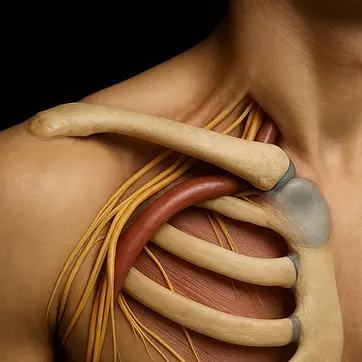
Definition and Description
Cervicobrachial syndrome is a collection of symptoms in which neck pain is combined with radiating pain or neurological symptoms in the upper extremity. It was previously referred to as 'lower cervical syndrome'. The condition is characterized by pain, numbness, weakness, and sometimes swelling in the neck, shoulder, and arm. In some cases, there is loss of strength or fine motor control in the hand.
The pain may follow a dermatomal pattern, usually associated with a spinal nerve root. When objective signs of nerve-root involvement are present, including sensory and motor deficits, the condition is more appropriately classified as cervical radiculopathy³.
In cervicobrachial syndrome, no single objectively documented cause may be identified. If clinical assessment reveals specific neurological or vascular abnormalities, more precise diagnoses should be used, such as thoracic outlet syndrome or myofascial pain syndrome⁴,⁵.
Clinically Relevant Anatomy
Cervicobrachial symptoms may arise from cervical radiculopathy, often associated with pathology at C5–C6 or C6–C7. Nerve roots from these segments contribute to the innervation of muscles including the deltoid, supraspinatus, infraspinatus, serratus anterior, rhomboids, and latissimus dorsi. Myotomal and dermatomal patterns do not always correspond perfectly. Another possible mechanism is neurogenic and/or vascular compression in the thoracic outlet, where the brachial plexus or subclavian artery or vein may be affected⁵.
Prevalence and Etiology
Cervicobrachialgia has been reported to be more common than isolated neck pain⁶. It is frequently seen in people performing manual work, particularly tasks involving repetitive movements, prolonged static neck posture, or work above shoulder height⁴.
Radhakrishnan and colleagues found that 32% of patients with cervicobrachial symptoms experienced recurrence during a 4.9-year follow-up period⁷.
Symptoms and Clinical Presentation
For cervicobrachial syndrome to be considered, the patient typically has neck pain together with neurological symptoms such as paresthesia, sensory disturbance, or motor weakness affecting the arm, hand, or fingers. Some patients report reduced strength or fine motor control, and some have difficulty holding objects.
Common symptoms include:
Pain and fatigue in the wrist, forearm, shoulder, and neck
A sensation of swelling or pressure in the hands
A feeling of 'heavy arms' or numbness
Symptoms that worsen with activity and improve with rest
Night pain and sleep disturbance
A glove-like sensation despite no external contact
Headache as an accompanying symptom⁴,⁵
The condition may also be associated with increased sensitivity to sensory input, particularly on the affected side. Studies have reported reduced postural control and elevated detection thresholds for sensory stimuli in patients with cervicobrachial syndrome compared with healthy individuals⁹.
Differential Diagnoses
There are many potential causes of neck and arm pain, and other disorders should be excluded before cervicobrachial syndrome is used as a diagnosis. Relevant differential diagnoses include:
Cervical radiculopathy
Myofascial pain syndrome
Thoracic outlet syndrome
Supraspinatus tendinopathy
Epicondylitis when forearm pain is prominent
Carpal tunnel syndrome when hand paresthesia is present
Rheumatic disorders such as rheumatoid arthritis and polymyalgia rheumatica
Infection or metastatic disease of the cervical spine
Spondylodiscitis
Syringomyelia
Raynaud's disease
Neuromuscular disorders such as poliomyelitis, muscular dystrophy, or motor neuron disease
Diagnostic Procedures
Before symptomatic treatment is initiated, assessment may include:
Clinical examination of the neck and shoulder
Cervical spine radiographs in multiple projections
Neurological referral when EMG, MRI, or CT is indicated
Angiography or venography when vascular compression is suspected
Imaging may identify anatomical variants such as a cervical rib or degenerative changes in the spine. MRI or CT provides detailed assessment of soft tissue and bony structures. EMG may help identify nerve injury, while angiography can be used to assess blood vessels when thoracic outlet syndrome is suspected⁵.
Outcome Measures
In patients with cervicobrachial syndrome, function can be assessed using the Northwick Park Neck Pain Questionnaire. This questionnaire has demonstrated good short-term reproducibility and sensitivity to change over longer follow-up periods.
Pain intensity can be measured with the Short-Form McGill Pain Questionnaire (SF-MPQ), which also includes Present Pain Intensity (PPI) and a visual analogue scale (VAS).
An objective physical outcome measure is cervical range-of-motion assessment, commonly referred to as Cervical Range of Motion (CROM), which can document restricted mobility and changes during treatment¹¹.
When wrist and forearm symptoms are also present, for example when secondary functional impairment is suspected, the Patient Rated Wrist Evaluation (PRWE) may be used. This 15-item questionnaire evaluates pain and disability during daily activities and is divided into two subscales:
Pain scale: Contains 5 questions, each rated from 0 to 10, giving a maximum score of 50.
Function scale: Contains 10 questions covering six specific activities and four usual activities. The maximum score is also 50.
Higher scores indicate greater pain and functional limitation¹².
Examination

Radiological imaging can be important for excluding structural causes of symptoms. X-ray, CT, or MRI may reveal degenerative changes, nerve-root involvement, or anatomical variants such as cervical ribs.
On clinical examination, the neck, shoulders, and arms may appear normal on inspection but be painful on palpation. The neck may be stiff, particularly in extension. Some patients show forward-head posture and rounded shoulders. Arm abduction may aggravate symptoms. Asymmetry of the upper thorax, including the clavicles, should also be assessed.
Tests that may be used to reproduce symptoms include:
Adson's test: The head is extended and rotated toward the affected side while the patient takes a deep breath. Reproduction of symptoms or vascular changes may support suspicion of thoracic outlet involvement.
Elevated Arm Stress Test (EAST): Sustained arm elevation and repeated hand opening and closing may reproduce symptoms and is commonly used when thoracic outlet syndrome is suspected.
Shoulder Abduction Test: The patient places the hand on top of the head. Reduction of radicular symptoms may suggest cervical nerve-root involvement.
Spurling's Test: Cervical lateral flexion and slight extension are combined with axial compression. Reproduction of radiating arm pain may support cervical radiculopathy.
Upper Limb Tension Test (ULTT): Assesses mechanosensitivity of neural tissue and is particularly sensitive for neurological symptoms in the upper extremity.
NTPT (Neural Tissue Provocation Test): Assesses median-nerve mechanosensitivity. If the patient cannot tolerate 90° of shoulder abduction, a modified version may be used¹³,¹⁴.
If the Shoulder Abduction Test and Spurling's Test are positive, cervical radiculopathy becomes more likely. If the upper-limb neural tension test is positive while the other tests are negative, cervicobrachial syndrome may be considered among the differential diagnoses.
Medical Treatment
Management of cervicobrachial syndrome is primarily conservative and symptom-oriented. Surgery is not generally indicated for the non-specific syndrome itself¹⁵.
Analgesics and muscle relaxants may be used for acute or chronic pain, and NSAIDs may also be considered when appropriate. When vascular compression is suspected, medical management depends on the underlying diagnosis and may include vasodilatory treatment under medical supervision.
Cervical epidural steroid injection may be considered in selected patients with cervical radicular pain and can provide short- or longer-term symptom relief. Reported effects include:
Pain relief
Improved cervical mobility
Reduced need for analgesic medication
Earlier return to work and function¹⁶
One study compared a single injection with continuous injections:
Single injection: an epidural block with bupivacaine and methylprednisolone administered at 4–5-day intervals.
Continuous treatment: epidural bupivacaine administered every 6, 12, or 24 hours, with methylprednisolone every 4–5 days.
The continuous-treatment group achieved greater pain relief than the single-injection group¹⁷.
Physiotherapy Management

Manual physiotherapy is a central component of conservative management for cervicobrachial pain. It has been reported to reduce pain, joint restriction, and functional limitation, particularly when combined with therapeutic exercise.
One study compared two forms of traction treatment: mechanical and manual traction.
Mechanical traction was performed in the supine position using adjustable equipment. Traction force was set at approximately 10–15% of body weight and applied using 10 seconds of traction followed by 5 seconds of rest for 10 minutes per session.
Manual traction was provided in the supine position with approximately 25° of cervical flexion, using the same traction-rest interval as the mechanical method. In addition, C3–C7 were mobilized with central posteroanterior glides in prone, each repetition held for 5 seconds for a total of 10 repetitions per session.
All patients in both groups were also prescribed active home exercises including mobility exercises, stretching, and isometric strengthening. The results indicated that mechanical traction was more effective than manual traction for reducing pain and disability.
Another study concluded that mechanical traction combined with exercise produced greater reductions in pain and disability in patients with cervical radiculopathy¹⁸. Moretti et al. also reported beneficial short- and long-term effects of manipulative treatment in mechanical cervicobrachialgia¹⁹.
Research has also suggested that mobilization combined with manipulation may provide a small beneficial effect compared with no treatment²⁰. A multimodal strategy combining mobilization, manipulation, and specific exercise may provide meaningful pain reduction²⁰.
Rehabilitation goals in conservative management of cervicobrachial syndrome can be divided into two main areas:
Pain reduction:
TENS (transcutaneous electrical nerve stimulation)
Cryotherapy
Deep-heat modalities when appropriate
Therapeutic ultrasound
Cognitive and behavioral pain-management strategies¹⁵
Deep-tissue massage²¹
Restoration of function and mobility:
Passive and indirect manual techniques
Mobilization techniques including cervical lateral glide²¹,²²
Active exercises for the neck, shoulder, and arm to improve mobility, strength, and endurance
Postural-control exercises, including specific programs for maintaining an appropriate cervical position during daily activities
Postural correction is a central component of exercise-based management. It begins with awareness of suboptimal posture, followed by correction using therapist feedback. Active exercises are then introduced in lying and standing while the patient maintains cervical control. Finally, these strategies are transferred to functional activities such as lifting and carrying. Such exercises may also reduce dizziness and neck pain while gradually improving postural control and endurance²⁰.
One study compared a contralateral glide technique with ultrasound and found that the glide technique increased upper-limb mobility and reduced pain, whereas ultrasound showed no documented benefit. The technique was performed as follows:
The therapist supported the patient's head and neck above the affected segment.
A lateral glide was applied away from the affected side without cervical side-bending or rotation.
Components of median-nerve neural provocation were added simultaneously to increase mechanical loading of the neural tissue.
If this position was uncomfortable, the arm was supported in a relaxed position with the hand on the abdomen and the elbow resting on a pillow²³.
SNAGs (sustained natural apophyseal glides) may also provide immediate symptom relief in selected patients. Strength and endurance exercises for the cervicothoracic and scapular musculature can be beneficial compared with no treatment. A combination of stretching, strengthening, and stabilization exercises for the cervical region has shown short-term pain relief, although benefits may not necessarily persist at intermediate follow-up.
Home exercise and ergonomic assessment are important elements of rehabilitation²¹. Assessment of working posture and loading patterns can identify contributing factors. Studies have reported improvements in pain intensity, pain quality, and functional ability after intervention.
Neck support during sleep may be considered as part of home management. One study reported that appropriate nighttime neck support reduced worsening of pain²⁴, while another found reduced post-treatment symptoms with specialized pillows²⁵.
Clinical Conclusion
Several studies have examined specific physiotherapy interventions such as manual therapy, cervical traction, strengthening, and postural control for cervicobrachial pain. However, few studies use clearly defined inclusion criteria. Future research should identify which subgroups of cervicobrachial pain respond best to specific interventions.
Sources:
DeStefano LA. Greenman’s Principles of manual medicine – 4th ed. Baltimore, MD : Lippincott Williams & Wilkins/Wollters Kluwer. 2011
Elvey RL, Hall T. Neural tissue evaluation and treatment. Physical Therapy of the Shoulder. New York: Churchill Livingstone. 1997
Yoon SH. Cervical radiculopathy. Phys Med Rehabil Clin N Am. 2011;22(3):439- 46
Aynesworth, Kenneth H. "The Cervicobrachial Syndrome." Annuals of Surgery 111 5 (1940): 727-742.
Jürgen Krämer et al; Intervertebral Disk Diseases, causes, diagnosis, treatment, and prophylaxis; Thieme 3th Edition 2009
Daffner . et al.. Impact of neck and arm pain on overall health status. Spine 2003;28(17):2030e5.
Radhakrishnan K et al. Epidemiology of cervicalradiculopathy. A population based study from Rochester, Minnesota, 1976 through to 1990. Brain 1994;117:325e35
Gross, A. R., et al. "Manipulation and Mobilisation for Mechanical Neck Disorders." Cochrane Database System Review 1 (2004): CD004249. National Center for Biotechnology Information. National Library of Medicine. 29 Oct. 2008
Elevated Detection Thresholds for Mechanical Stimuli in Chronic Pain Patients: Support for a Central Mechanism; Voerman et al. ; 2000 ;
Gross, A. R., et al. "Physical Medicine Modalities for Mechanical Neck Disorders." Cochrane Database System Review 2 (2000): CD000961. National Center for Biotechnology Information. National Library of Medicine. 29 Oct. 2008
Cowell IM., Phillips DR., Effectiveness of manipulative physiotherapy for the treatment of a neurogenic cervicobrachial pain syndrome: a single case study - experimental design, Manual Therapy. 2002 Feb;7(1):31-8.
MacDermid JC et al. Patient rating of wrist pain and disability: a reliable and valid measurement tool.; Gifford et al. Acute low cervical nerve root conditions: symptom presentations and pathobiological reasoning. Manual Therapy (2001) 6(2), 106–115
Majid Ghasemi et al. ; The value of provocative tests in diagnosis of cervical radiculopathy; march 2013
Van Der Heide B et al. Test-Retest Reliability and Face Validity of a Modified Neural Tissue Provocation Test in Patients with Cervicobrachial Pain Syndrome. The journal of manual & manipulative therapy, 2006
Salt E. et al., A systematic literature review on the effectiveness of non-invasive therapy for cervicobrachial pain, Manual Therapy, 2011 Feb;16(1),53-65
tav.A. et al.;CERVICAL EPIDURAL STEROID INJECTION FOR CERVICOBRACHIALGIA; 1993;
Alberto MD et al.Epidural Local Anesthetic Plus Corticosteroid for the Treatment of Cervical Brachial Radicular Pain: Single Injection Versus Continuous Infusion, Pasqualucci,
Fritz JM, Thackeray A, Brennan GP, Childs JD. Exercise only, exercise with mechanical traction, or exercise with over-door traction for patients with cervical radiculopathy, with or without consideration of status on a previously described subgrouping rule: a randomized clinical trial.
Moretti B et al. Manipulative therapy in the treatment of benign cervicobrachialgia of mechanical origin. Chir Organi Mov. 2004 Jan-Mar;89(1):81-6
Anita R. Gross et al.A Cochrane Review of Manipulation and Mobilization for Mechanical Neck Disorders;; 2004
Allison GT, Nagy BM, Hall T., A randomized clinical trial of manual therapy for cervico-brachial pain syndrome -- a pilot study, Manual Therapy. 2002 May;7(2):95-102.
Coppieters MW, Stappaerts KH, Wouters LL, Janssens K., The immediate effects of a cervical lateral glide treatment technique in patients with neurogenic cervicobrachial pain, Journal of orthopedics and sports Phys. Ther., 2003 Jul;33(7):369-78.
Michel W. Coppieters et al. The Immediate Effects of a Cervical Lateral Glide Treatment Technique in Patients With Neurogenic Cervicobrachial Pain;
Bernateck M et al. Sustained effects of comprehensive inpatient rehabilitative treatment and sleeping neck support in patients with chronic cervicobrachialgia: a prospective and randomized clinical trial. Int J Rehabil Res. 2008 Dec;31(4):342-6
Gutenbrunner C et al. Prospective study of the long-term effectiveness of inpatient rehabilitation of patients with chronic cervicobrachial syndromes and the effect of prescribing special functional pillows. Rehabilitation (Stuttg). 1999 Aug;38(3):170-6


