

Exercise-Induced Bronchoconstriction (Exercise-Induced Asthma)

Exercise-induced bronchoconstriction (EIB) is a temporary and reversible contraction of bronchial smooth muscle that occurs after physical exertion. The condition, previously referred to as exercise-induced asthma, can cause symptoms such as shortness of breath, chest tightness, wheezing and coughing, but may also occur without noticeable symptoms¹.
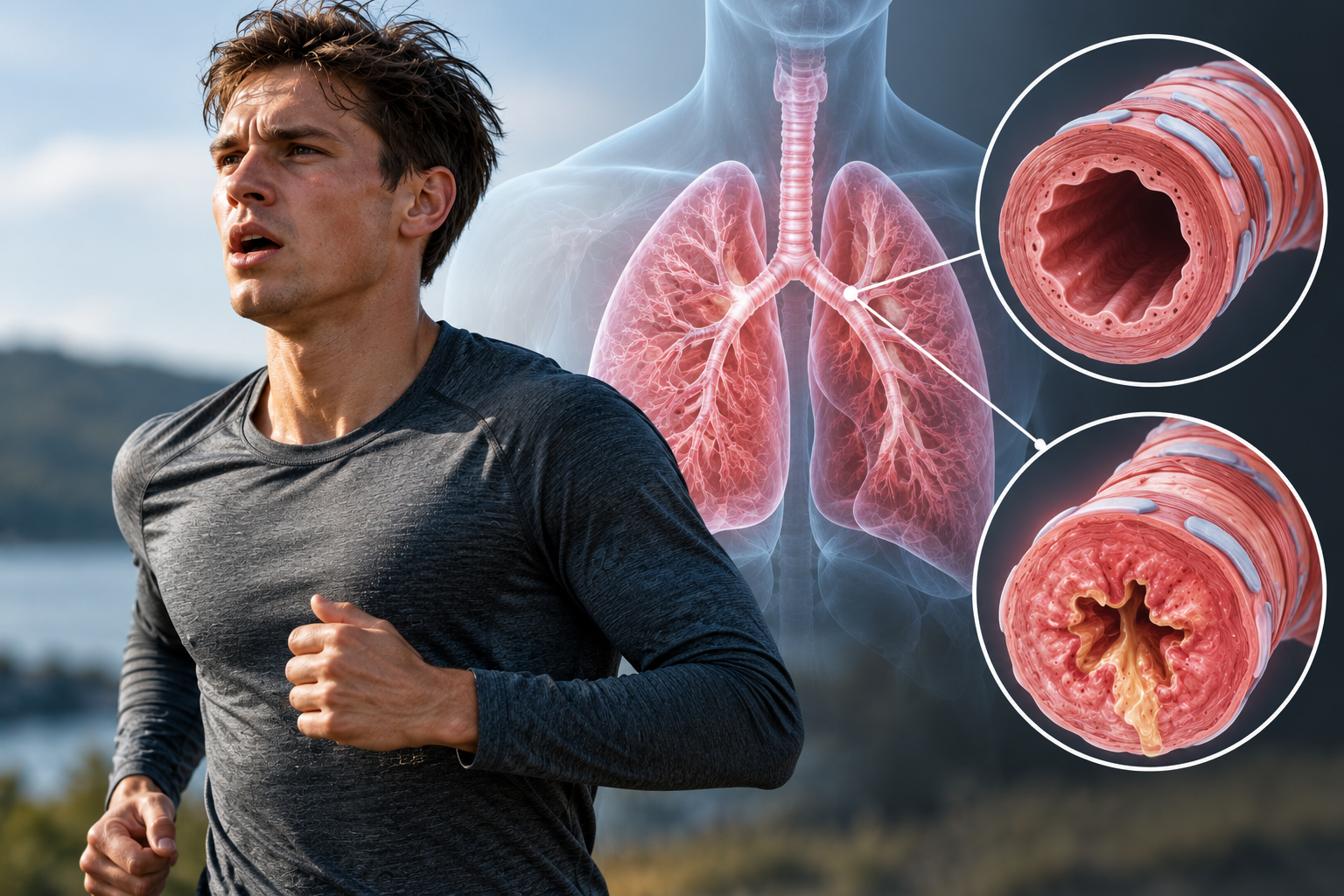
EIB is common among people with asthma, affecting between 40% and 90% of this group. However, it is important to note that people without known asthma can also develop EIB, with an estimated prevalence of up to 20%¹. Regular physical activity is a central component of good health and has documented benefits across all age groups. The paradox of EIB is that physical activity—despite being able to trigger symptoms—has also been shown to reduce disease severity, improve lung function and reduce airway inflammation in people with asthma and EIB¹.
Symptoms cause many people to avoid physical activity, which can in turn lead to social isolation, particularly among adolescents, and increase the risk of overweight and poor general health. Early diagnosis, confirmed by measuring changes in lung function during exercise, and individualized treatment can significantly improve quality of life. With appropriate follow-up, people with EIB can participate fully in physical activity—including at elite level¹.
Prevalence and risk groups
EIB affects not only people with asthma but also a substantial proportion of people without known airway disease. Among elite athletes, prevalence is considerably higher and ranges from 30% to 70%². The condition is particularly common among winter-sport athletes. Nearly half of cross-country skiers and 43% of short-track speed skaters report symptoms of EIB². Globally, it is estimated that around 400 million people will have asthma in 2024, and a large proportion of these are also expected to experience exercise-induced bronchoconstriction¹. Approximately 250,000 people die each year as a result of asthma-related complications¹.
Causes and triggering factors
EIB is triggered by the rapid increase in ventilation that occurs during exercise, which increases the demand for warming and humidifying inspired air. In susceptible individuals, this leads to inflammation, neurogenic responses and vasodilation, collectively resulting in bronchial constriction. The result is symptoms such as shortness of breath, coughing, mucus production, wheezing and chest tightness¹,³.
Asthma itself results from complex interactions between genetic predisposition and environmental exposures. The substantial increase in asthma cases over recent decades suggests that environmental factors, such as allergen exposure, play a central role in the sensitization process⁴.
Factors that may worsen or trigger EIB include:
Cold and dry air
Pollution such as smoke or smog
High pollen levels
Respiratory infections, such as COVID-19
Exposure to chemicals, such as chlorine in swimming pools⁵
Symptoms and clinical presentation
Symptoms of EIB usually occur 5 to 8 minutes after intense aerobic activity and can range from mild to moderate. The most common symptoms are shortness of breath, coughing, chest tightness and wheezing. In rare cases, severe symptoms with respiratory failure may occur.
Symptoms:
Occur more frequently in environments with cold, dry air or high concentrations of irritants
Usually resolve spontaneously within 30 to 90 minutes
Are often followed by a refractory period of 1 to 3 hours, during which further activity does not trigger bronchoconstriction
May be absent, meaning EIB can remain undiagnosed¹
Risk factors include:
Personal or family history of asthma
Allergic rhinitis or atopy
Exposure to cigarette smoke
Participation in high-risk sports (e.g. long-distance running, swimming, skiing, cycling, water polo and ice hockey)
Exercise in areas with high levels of air pollution
Female sex¹
Diagnosis and assessment
A thorough history and clinical examination are essential for determining whether physical activity triggers the symptoms.
Standardized diagnosis is primarily based on measuring changes in lung function. This includes:
Spirometry: Measurement of FEV1 before and after exercise. A fall in FEV1 of ≥10% confirms EIB³
Bronchial provocation testing:
Direct testing: Methacholine is used to stimulate bronchial smooth muscle. Sensitivity ranges from 58.6% to 91.1%
Indirect testing: Physical exercise in a controlled environment with cold, dry air
Alternative tests: Eucapnic voluntary hyperventilation, dry-powder mannitol or hyperosmolar saline solution (4.5%)³
Treatment and follow-up
With correct diagnosis and treatment, EIB should not limit participation in physical activity. Good asthma control enables full participation—including at a high level⁶.
Treatment should include:
Identification and elimination of triggering factors
Patient education on trigger control
Medication when required⁴
Recommended treatment options⁶:
Long-term treatment (when control is poor):
Inhaled corticosteroids: Reduce inflammation and help prevent EIB when used daily
Before physical activity:
Beta2-agonists
Short-acting beta2-agonists (SABA): Taken immediately before activity and provide protection for 2–3 hours
Long-acting beta2-agonists (LABA): Used in combination with inhaled corticosteroids and may provide an effect for up to 12 hours. They should not be used daily without other treatment
Leukotriene receptor antagonists (LTRA)
Used to help prevent symptoms, but have a slower onset of action
Warm-up before activity
Gradually increasing intensity may reduce the risk of bronchoconstriction
Protection from cold air
Use of a scarf or mask over the mouth and nose during activity in cold air
Medication use in competitive sport
For elite athletes, the use of asthma medication is subject to strict regulations. Many international sports organizations require documentation of EIB, often through bronchial provocation testing, before such medication can be approved for use in competition³. It is essential that anyone competing at a high level checks the current regulations before using medication, including prescription drugs.
Physiotherapy management of exercise-induced asthma
Physiotherapists play a central role in managing patients with exercise-induced bronchoconstriction (EIB), through acute intervention, education and long-term follow-up. An important part of treatment is ensuring that the patient receives safe and accurate information about how physical activity can be performed without worsening symptoms. Physiotherapists should also be able to recognize warning signs and contribute to early identification of EIB in patients who have not yet received a formal diagnosis.
Education and prevention
In addition to following medical recommendations and using prescribed medication, the following strategies may help many people with EIB:
Warming up before physical activity to reduce the risk of bronchoconstriction
Good general fitness can increase the threshold at which symptoms are triggered, making moderate exercise easier to tolerate
Exercising in warm and humid environments may have a protective effect on the airways
Avoiding environments with high levels of allergens, pollution, irritating gases or particles
Nasal breathing to warm and humidify inspired air
Using a mask that filters cold air, although this may be impractical in some settings
Cooling down after exercise, breathing through the nose and covering the mouth in cold weather
Patients who smoke should be advised to contact their physician for smoking-cessation support
Acute management during treatment
During an acute asthma attack in a physiotherapy session, the therapist must rapidly assess severity. The patient should be positioned in high Fowler's position (sitting upright with back support) to facilitate diaphragmatic breathing and, when appropriate, pursed-lip breathing. If the patient has an inhaler available, the therapist should facilitate self-administration while helping the patient remain calm to reduce sympathetic activation⁷.
Long-term follow-up and exercise
Many people with EIB avoid physical activity because they fear worsening their symptoms. Although evidence for breathing techniques and inspiratory muscle training in people with asthma remains limited, physical activity is well documented to substantially improve cardiorespiratory fitness in this population⁷. Physiotherapists therefore have an important role in guiding patients through safe and individually adapted exercise initiation.
Studies are also investigating the effect of physiotherapy on quality of life in children with asthma, which may provide further evidence for physiotherapy interventions in the future⁸.
According to the Guide to Physical Therapist Practice, preferred practice patterns for patients with EIB include⁹:
Pattern 6B: Impaired aerobic capacity/endurance associated with deconditioning
Pattern 6C: Impaired ventilation, respiration/gas exchange and aerobic capacity associated with airway-clearance dysfunction
Pattern 6E: Impaired ventilation and respiration/gas exchange associated with ventilatory-pump dysfunction
Pattern 6F: Impaired ventilation and respiration/gas exchange associated with respiratory failure
Interaction between medication and physical activity
Patients should be instructed to use bronchodilators with a metered-dose inhaler (MDI) approximately 20–30 minutes before planned activity. During the same period, the patient should perform light stretching and warm-up. The physiotherapist must be aware of adverse effects and signs of medication toxicity, including nausea, tremor, restlessness, tachycardia, arrhythmias and hypotension⁷. If the patient develops symptoms that are not controlled by the current medication, the physiotherapist should contact the responsible physician to consider dose adjustment.
Monitoring vital signs
The physiotherapist should monitor vital signs before, during and after physical activity to identify abnormal changes in bronchopulmonary function. Lung auscultation should be performed routinely to identify abnormal breath sounds, wheezing or rhonchi. Warning signs of worsening asthma or medication reactions include tachypnea, diarrhea, headache and vomiting. Hypoxemia may present as an abnormal increase in blood pressure⁷.
Other considerations in long-term management
Long-term use of inhaled corticosteroids can be associated with reduced bone mineral density, particularly in patients with moderate to severe asthma. This may increase fracture risk, including asymptomatic vertebral fractures. Physiotherapists should be aware of the patient's medication history and use caution with high-load exercise in this group. Physiotherapy can complement medical treatment in status asthmaticus, with emphasis on secretion-clearance techniques, reducing hypoxemia and improving ventilation-perfusion matching. Aggressive techniques such as forceful percussion should be avoided to prevent bronchospasm⁷.
Differential diagnoses for exercise-induced symptoms
Symptoms such as chest tightness, wheezing, coughing and shortness of breath during exercise can be caused by several different airway conditions. EIB cannot be diagnosed solely on the basis of symptoms; objective measurement of reduced lung function during or after exercise is required¹.
Common differential diagnoses include¹⁰:
Vocal cord dysfunction
Laryngeal or tracheal disorders
Respiratory infection
Gastroesophageal reflux
Hyperventilation syndromes
EIB may also occur in association with underlying conditions such as¹¹:
COPD
Obesity
Pectus excavatum
Diaphragmatic paralysis
Interstitial fibrosis
Sources:
Gerow M, Bruner PJ. Exercise Induced Asthma. Treasure Island, FL: StatPearls. 2020.: https://www.ncbi.nlm.nih.gov/books/NBK557554/
The Conversation Winter Olympics: why many athletes will be struggling with asthma :https://theconversation.com/winter-olympics-why-many-athletes-will-be-struggling-with-asthma-90400
Asthma org. EIB :https://asthma.org.au/about-asthma/triggers/exercise-induced-bronchoconstriction/
Goodman CC, Snyder TE. Differential Diagnosis for Physical Therapists, Screening for Referral. W B Saunders Company; 2012. 298
"Exercise-induced asthma." Mayo Clinic. N.p., n.d. Web. 25 Mar. 2014. <http://www.mayoclinic.org/diseases-conditions/exercise-induced-asthma/basics/definition/con-20033156>.
Expert Panel Report 3 (EPR3): Guidelines for the Diagnosis and Management of Asthma. Section 4, Managing Asthma Long Term—Special Situations. http://www.nhlbi.nih.gov/guidelines/asthma.
Goodman CC, Snyder TE. Differential Diagnosis for Physical Therapists, Screening for Referral. W B Saunders Company; 2012.772-774
Zhang W, Liu L, Yang W, Liu H. Effectiveness of physiotherapy on quality of life in children with asthma: Study protocol for a systematic review and meta-analysis. Medicine. 2019 Jun;98(26).
APTA Guide to Physical Therapist Practice-Online. Cardiovascular/Pulmonary Preferred Practice Patterns. http://guidetoptpractice.apta.org/content/current
Schumacher Y, Pottgiesser T, Dickhuth H. Exercise-induced bronchoconstriction: Asthma in athletes. International Sportmed Journal [serial online]. December 2011;12(4):145-149: SPORTDiscus with Full Text, Ipswich, MA.
Weiler JM, Anderson SD, Randolph C, et al. Pathogenesis, prevalence, diagnosis, and management of exercise-induced bronchoconstriction: a practice parameter. Ann. Allergy. Asthma Immunol. 2010;105(6 Suppl):S1–47. http://www.ncbi.nlm.nih.gov/pubmed/21167465. .


