

Mallet Finger

Updated: Oct 6
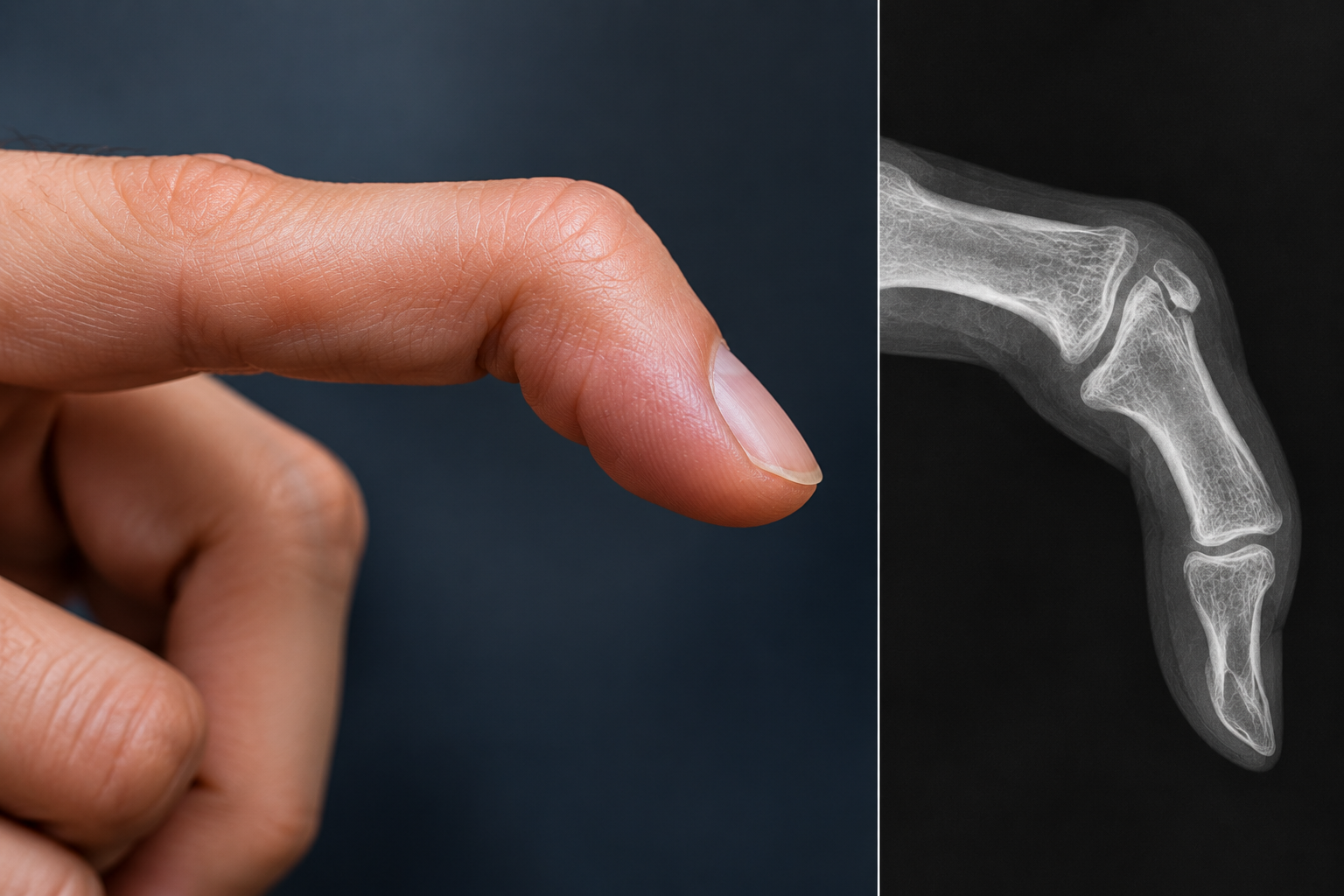
Mallet finger is an injury that occurs when the extensor tendon of the distal interphalangeal joint (DIP) ruptures or avulses a fragment of bone from the distal phalanx.¹ This leads to the inability to actively extend the fingertip, producing the characteristic drooping distal joint. The injury typically happens when the fingertip is struck by a ball or similar object while in an extended position.¹
Clinically Relevant Anatomy
• The extensor tendons lie dorsally across the hand and extend the fingers through a complex network of tendons and aponeuroses.²
• They originate in the forearm, cross the metacarpophalangeal joint, and insert onto the distal phalanx.
• These tendons are essential for extension of both the wrist and fingers.
Etiology
• The injury occurs when the distal phalanx is forcibly flexed while the extensor tendon is actively contracting, often during ball sports.¹
• In high-energy trauma, the tendon may avulse a bone fragment (mallet fracture).
• Early treatment is essential to prevent poor healing.³
Epidemiology
• Mallet finger accounts for approximately 5.6% of all hand and wrist injuries.⁴
• Most commonly affects young men during sports but can also occur in older adults during daily tasks such as pulling up socks.³
• The injury is most frequently seen in the middle and ring fingers of the dominant hand.⁵
Clinical Presentation
• Acute injury mechanism with a clear history of trauma.
• The finger rests in a flexed posture and cannot be actively extended at the DIP joint.
• Passive extension is possible.
• Swelling and pain are common at the time of injury, particularly with avulsion fractures.⁶
Differential Diagnoses
• Swan-neck deformity
• Boutonnière deformity
Diagnostic Procedures
• The diagnosis is primarily clinical.
• X-rays (AP and lateral views) are used to detect fractures or bone fragments.⁶
• Ultrasound may assist in locating a retracted tendon.
• MRI is rarely indicated.
Management
General Principles
• A 2018 systematic review found that both surgical and non-surgical treatments yield good results, and the choice should be individualised.⁷,⁸
Conservative Management
• Continuous splinting for 6–8 weeks is standard.
• The splint must be worn at all times, including during showering, to maintain DIP extension.
• If the joint bends during treatment, the process restarts from day one.
• After 6–8 weeks, splint use is gradually reduced while exercises are introduced to restore motion.
• Patient education about strict immobilisation is critical for optimal outcomes.³
Surgical Management
• Surgery is indicated for large bone fragments, malalignment, or open injuries.⁶
• Should be performed promptly, followed by rehabilitation.
• Lin et al. (2018) reported a mean residual extension lag of 5.7° after surgery and 7.6° after conservative care.⁷
Physiotherapy and Rehabilitation
Training protocol after splinting:
• Passive range of motion to restore mobility.
• Active extension exercises to strengthen the extensor tendon.
• Place-and-hold drills to stimulate tendon activation.
• Scar massage to reduce adhesions.
• Tendon-gliding exercises to prevent fibrosis and ensure smooth tendon excursion.
In some cases, a temporary fixation pin may be inserted in patients needing early hand use (e.g., surgeons), typically removed after six weeks. In chronic cases, splinting up to 12 weeks can be tried before surgery is considered.³,⁶
Complications
• Residual extension deficit
• Swan-neck deformity due to volar plate instability and weakened extensor tendon¹
Conclusion
Mallet finger is a common injury usually treated conservatively, though surgery may be necessary in cases with significant fracture or malalignment. Rapid diagnosis and adherence to splinting are key for success. Early physiotherapy initiation is important for restoring function.³,⁷
References
Yee J, Waseem M. Mallet Finger Injuries. InStatPearls [Internet] 2019 May 5. StatPearls Publishing https://www.ncbi.nlm.nih.gov/books/NBK459373/
Brotzman S.B., Manske R.C. Clinical Orthopaedic Rehabilitation: An Evidence-Based Approach, Elsevier Health Sciences, 2011
Ramponi DR, Hellier SD. Mallet finger. Advanced emergency nursing journal. 2019 Jul 1;41(3):198-203.
de Jong JP, Nguyen JT, Sonnema AJ, Nguyen EC, Amadio PC, Moran SL. The incidence of acute traumatic tendon injuries in the hand and wrist: a 10-year population-based study. Clinics in orthopedic surgery. 2014 Jun 1;6(2):196-202.
Botero SS, Diaz JJ, Benaïda A, Collon S, Facca S, Liverneaux PA. Review of acute traumatic closed mallet finger injuries in adults. Archives of plastic surgery. 2016 Mar;43(2):134.
APA Mallett Finger : https://choose.physio/your-body/fingers/mallet-finger
Lin JS, Samora JB. Surgical and nonsurgical management of mallet finger: a systematic review. The Journal of hand surgery. 2018 Feb 1;43(2):146-63.
Smit JM, Beets MR, Zeebregts CJ, Rood A, Welters CF. Treatment options for mallet finger: a review. Plastic and reconstructive surgery. 2010 Nov 1;126(5):1624-9.
Total Physio Mallett finger : http://www.total-physio.com/Injuries-Conditions/Hand/Hand-Issues/Mallet-Finger-Injuries/a~287/article.html
Johnson C, Swanson M, Manolopoulos K. A case report: Treatment of a zone III extensor tendon injury using a single relative motion with dorsal hood orthosis and a modified short arc motion protocol. Journal of Hand Therapy. 2019 May 10.
Gjennomgått - Trukket
Thillemann JK, Thillemann TM, Kristensen PK, Foldager-Jensen AD, Munk B. Splinting versus extension-block pinning of bony mallet finger: a randomized clinical trial. Journal of Hand Surgery (European Volume). 2020 Apr 26:1753193420917567.
Gjennomgått - Trukket
Gjennomgått - Trukket


